
Cambridge Has been Here a While
Est. July 1761 — Washington County, New York

Cambridge Has been Here a While
Est. July 1761 — Washington County, New York

1760's - 1850's
1760's - 1850's
Settling the Valley
Settling the Valley
The Cambridge Patent set aside 30,000 acres between the Battenkill and Hoosick rivers in 1761, but permanent settlement took time. By around 1770, families were beginning to establish farms across the district, drawn to the broad, fertile land of the valley. Cambridge held its first recorded town meeting in 1773, beginning a tradition of local government that predates the United States itself.
Over the following decades, farms became roads, crossroads became hamlets, and distinct communities took shape. Cambridge Corners grew to the west, North White Creek to the east, with Dorr's Corners between them. The Northern Turnpike connected the valley with larger markets to the north and south. Eventually there was enough commercial and agricultural activity to support mills, shops, churches and small workshops. This would turn what was a few scattered settlements into something recognizable as a community. However, the Owl Kill creek, which drives through the center of the village, would continue to act as a barrier between East and West.
The Cambridge Patent set aside 30,000 acres between the Battenkill and Hoosick rivers in 1761, but permanent settlement took time. By around 1770, families were beginning to establish farms across the district, drawn to the broad, fertile land of the valley. Cambridge held its first recorded town meeting in 1773, beginning a tradition of local government that predates the United States itself.
Over the following decades, farms became roads, crossroads became hamlets, and distinct communities took shape. Cambridge Corners grew to the west, North White Creek to the east, with Dorr's Corners between them. The Northern Turnpike connected the valley with larger markets to the north and south. Eventually there was enough commercial and agricultural activity to support mills, shops, churches and small workshops. This would turn what was a few scattered settlements into something recognizable as a community. However, the Owl Kill creek, which drives through the center of the village, would continue to act as a barrier between East and West.

1850's
1850's
The Railroad Arrives
The Railroad Arrives
The new rail line linked Cambridge with rail centers in Troy and Albany and from there, markets far beyond New York. Prior, most trade was local, otherwise, goods were transported via horse and wagon or the Battenkill River (the river was a hub for the Beaver fur trade which allowed the Valley to develop a unique relationship with Quebec for a time). The railroad fundamantally changed the scale of what Cambridge could buy and sell.
The new rail line linked Cambridge with rail centers in Troy and Albany and from there, markets far beyond New York. Prior, most trade was local, otherwise, goods were transported via horse and wagon or the Battenkill River (the river was a hub for the Beaver fur trade which allowed the Valley to develop a unique relationship with Quebec for a time). The railroad fundamantally changed the scale of what Cambridge could buy and sell.
1866
1866
1866
A devastating fire tore through the West End. Because there was no local fire department, the fire was only subdued by neighboring villages arriving with fire brigades. This event catalyzed The East & West End's coming together to incorporate the Village of Cambridge.
A devastating fire tore through the West End. Because there was no local fire department, the fire was only subdued by neighboring villages arriving with fire brigades. This event catalyzed The East & West End's coming together to incorporate the Village of Cambridge.
A devastating fire tore through the West End. Because there was no local fire department, the fire was only subdued by neighboring villages arriving with fire brigades. This event catalyzed The East & West End's coming together to incorporate the Village of Cambridge.

Prior to 1866 Cambridge was composed of several hamlets noted on this map. The hamlets west of the Owl Kill made up the 'West End' and those on the opposite side were the 'East End'.
The Owl Kill created a natural barrier through regular flooding.
Prior to 1866 Cambridge was composed of several hamlets noted on this map. The hamlets west of the Owl Kill made up the ‘West End’ and those on the opposite side were the ‘East End’.
The Owl Kill created a natural barrier through regular flooding.
Prior to 1866 Cambridge was composed of several hamlets noted on this map. The hamlets west of the Owl Kill made up the 'West End' and those on the opposite side were the 'East End'.
The Owl Kill created a natural barrier through regular flooding.
1870 - Early 1900's
1870 - Early 1900’s
Cambridge In Bloom
Cambridge In Bloom

Barton Furniture Building

The Hotel Cambridge


Rice Seed Co.
Rice Seed Co.
Barton Furniture Building
Barton Furniture Building
The Hotel Cambridge
The Hotel Cambridge
Cambridge's prosperity had been building for decades. The Northern Turnpike brought travelers and commerce through the valley, supporting taverns, hotels, merchants and local trade. Mills and workshops followed. By the latter nineteenth century, Cambridge was making furniture, carriages, stoves, agricultural machinery and the locally famous Cambridge steel plow. Mial Barton's growing furniture business occupied the Main Street building that survives today as the Cambridge Antique Center.
The railroad multiplied the possibilities. By the 1880s, the rail yard had become a hub of commercial activity. Warehouses handled seeds, flour, grain, hardware, lumber, coal, produce and machinery. Cambridge-made plows and carriages could reach distant customers, while passenger trains brought visitors and lecturers into the village.
By 1891, Cambridge had five blacksmith shops, four carriage manufacturers, numerous merchants and professional offices, a new Union School, electric streetlights and a growing fair. This was Cambridge at its busiest: a small village with an outsized commercial and cultural life.
At the center of this prosperity stood the J.B. Rice Seed Company.
Cambridge's prosperity had been building for decades. The Northern Turnpike brought travelers and commerce through the valley, supporting taverns, hotels, merchants and local trade. Mills and workshops followed. By the latter nineteenth century, Cambridge was making furniture, carriages, stoves, agricultural machinery and the locally famous Cambridge steel plow. Mial Barton's growing furniture business occupied the Main Street building that survives today as the Cambridge Antique Center.
The railroad multiplied the possibilities. By the 1880s, the rail yard had become a hub of commercial activity. Warehouses handled seeds, flour, grain, hardware, lumber, coal, produce and machinery. Cambridge-made plows and carriages could reach distant customers, while passenger trains brought visitors and lecturers into the village.
By 1891, Cambridge had five blacksmith shops, four carriage manufacturers, numerous merchants and professional offices, a new Union School, electric streetlights and a growing fair. This was Cambridge at its busiest: a small village with an outsized commercial and cultural life.
At the center of this prosperity stood the J.B. Rice Seed Company.

J.B. Rice's Mansion
J.B. Rice's Mansion

The Great Cambridge Fair
JB Rice Seed Co.
JB Rice Seed Co.
Seed had been part of Cambridge's economy since the mid-nineteenth century, but under Jerome B. Rice it became something much larger. By the turn of the twentieth century, the J.B. Rice Seed Company employed roughly 200 people in Cambridge and distributed flower and field seeds across much of the country. Its great warehouse rose beside the railroad in 1879, followed by its brick office building in 1895.
Rice's influence reached well beyond the company itself. Jerome Rice donated land for Cambridge's Union School, helped bring electric power to the village and played a leading role in moving the Cambridge Fair from Lake Lauderdale to new fairgrounds north of the village. At its height, the fair drew enormous crowds by special train; 30,000 to 40,000 visitors were common in the early twentieth century.
The prosperity of this era left its mark. Hubbard Hall opened in 1878. New commercial buildings rose along Main Street. Churches, hotels and substantial homes reshaped the village. The Rice warehouse and office, Hubbard Hall, St. Luke's and scores of nineteenth-century houses still make that period visible today.
Rice Seed finally closed in 1976. By then, the railroad carried fewer passengers, old industries had disappeared and I-87 shifted regional travel elsewhere. But Cambridge had retained something many places lost.
Much of the village they built was still standing.
Seed had been part of Cambridge’s economy since the mid-nineteenth century, but under Jerome B. Rice it became something much larger. By the turn of the twentieth century, the J.B. Rice Seed Company employed roughly 200 people in Cambridge and distributed flower and field seeds across much of the country. Its great warehouse rose beside the railroad in 1879, followed by its brick office building in 1895.
Rice’s influence reached well beyond the company itself. Jerome Rice donated land for Cambridge’s Union School, helped bring electric power to the village and played a leading role in moving the Cambridge Fair from Lake Lauderdale to new fairgrounds north of the village. At its height, the fair drew enormous crowds by special train; 30,000 to 40,000 visitors were common in the early twentieth century.
The prosperity of this era left its mark. Hubbard Hall opened in 1878. New commercial buildings rose along Main Street. Churches, hotels and substantial homes reshaped the village. The Rice warehouse and office, Hubbard Hall, St. Luke’s and scores of nineteenth-century houses still make that period visible today.
Rice Seed finally closed in 1976. By then, the railroad carried fewer passengers, old industries had disappeared and I-87 shifted regional travel elsewhere. But Cambridge had retained something many places lost.
Much of the village they built was still standing.
1978 - Today
It's all Still Here
It's all Still Here
In 1978, 105 acres of Cambridge were listed on the National Register of Historic Places. The district encompasses the historic heart of the village and contains roughly 240 buildings, most dating from the nineteenth century. Federal houses stand beside Greek Revival homes and late-Victorian storefronts, churches and civic buildings.
But Cambridge is not preserved behind glass.
Hubbard Hall, built in 1878 as a village opera house, still welcomes audiences and artists. St. Luke's, built in the year Cambridge incorporated, still stands with its historic interior and Tiffany work. The Rice Seed buildings remain beside the railroad. The old Barton Furniture building now welcomes antique hunters. And the grand passenger depot, built at the opening of the twentieth century, has once again become a place where Cambridge gathers.
The businesses have changed. Trains no longer bring crowds to the fair. Seed catalogs no longer leave Cambridge by the thousands.
The streets, buildings and landscape they helped shape remain.
Walk Main Street

St. Luke
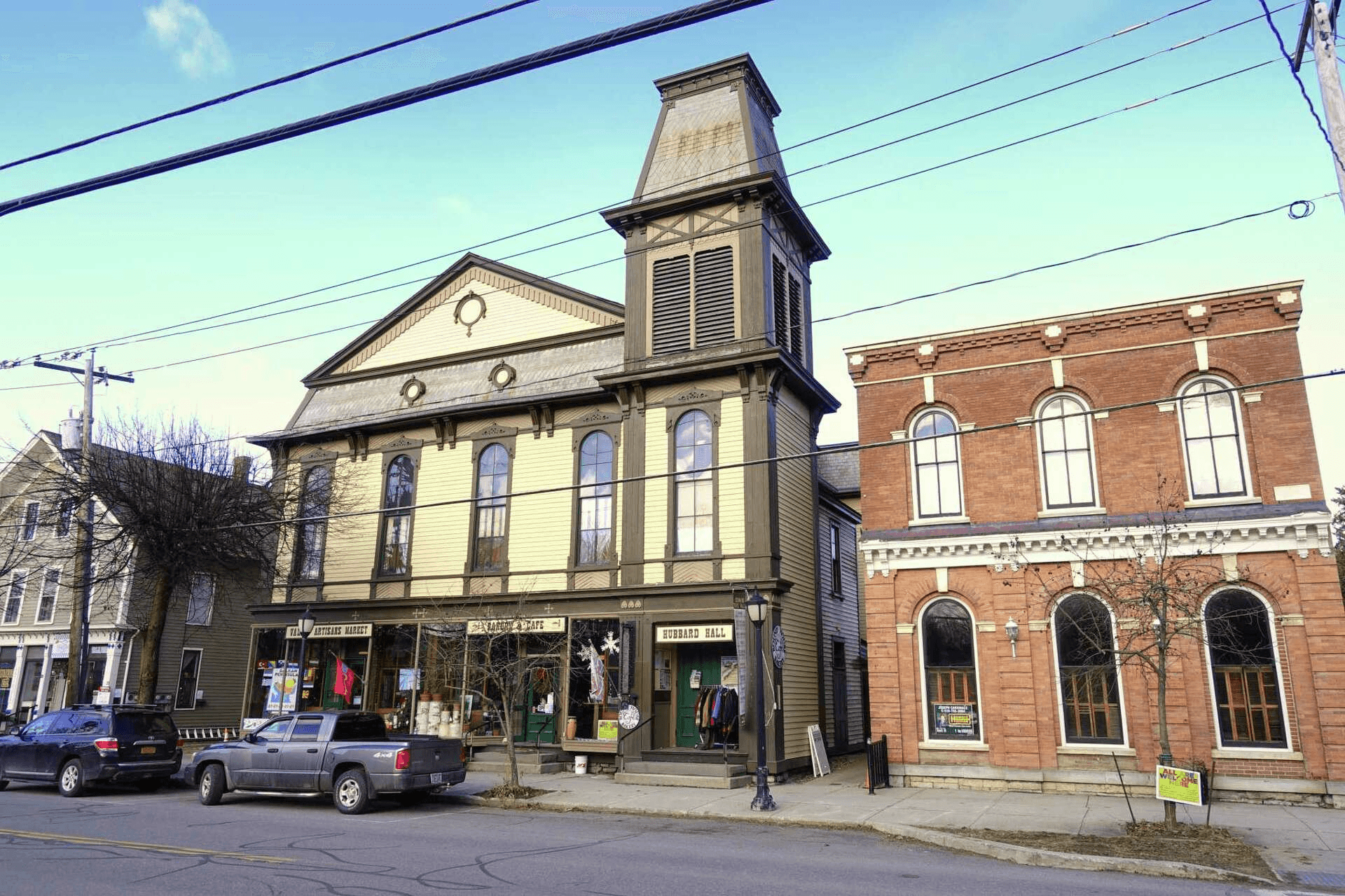
Hubbard Hall

Cambridge Hotel
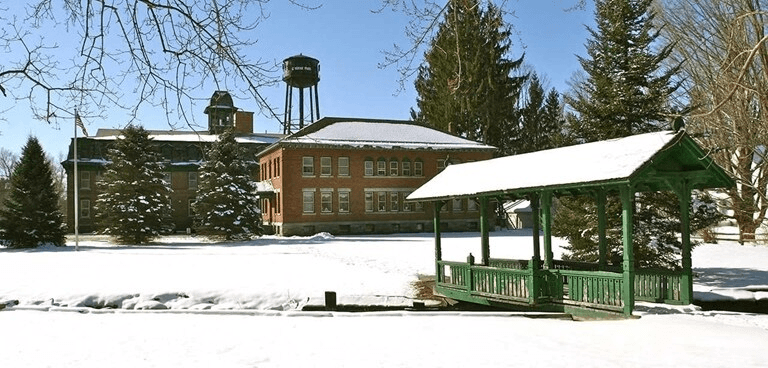
Rice Seed Buildings


Barton Building
LiveCambridge.org
An independent guide to visiting, living in, and discovering Cambridge, New York.

© 2026 Woodcock Management & Advisory LLC
LiveCambridge.org is independently operated by Woodcock Management & Advisory LLC.
LiveCambridge.org
An independent guide to visiting, living in, and discovering Cambridge, New York.
© 2026 Woodcock Management & Advisory LLC
LiveCambridge.org is independently operated by Woodcock Management & Advisory LLC.